1982-83

b.c. rich eagle

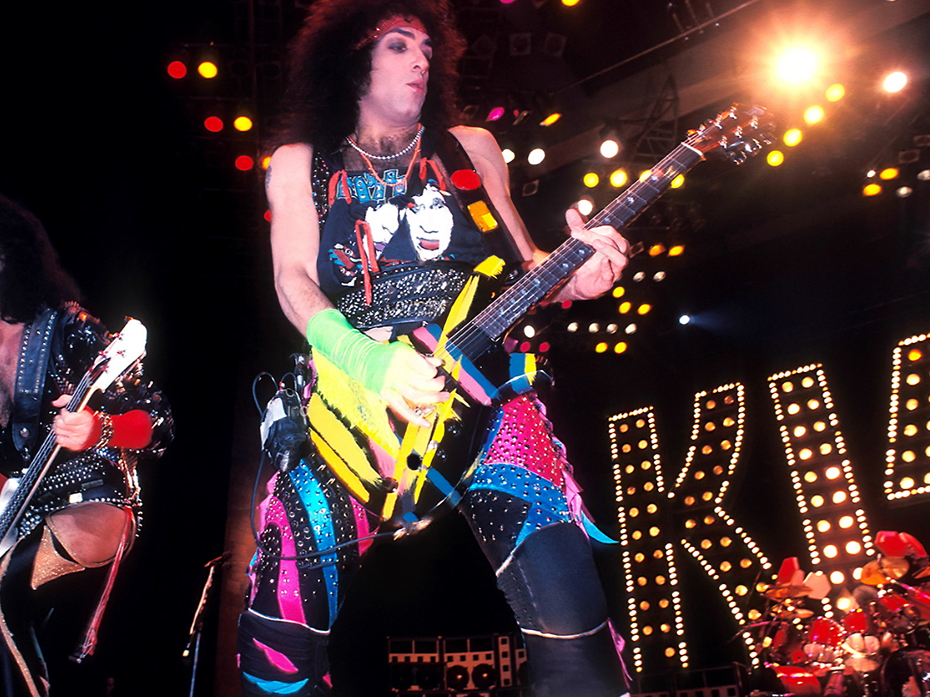
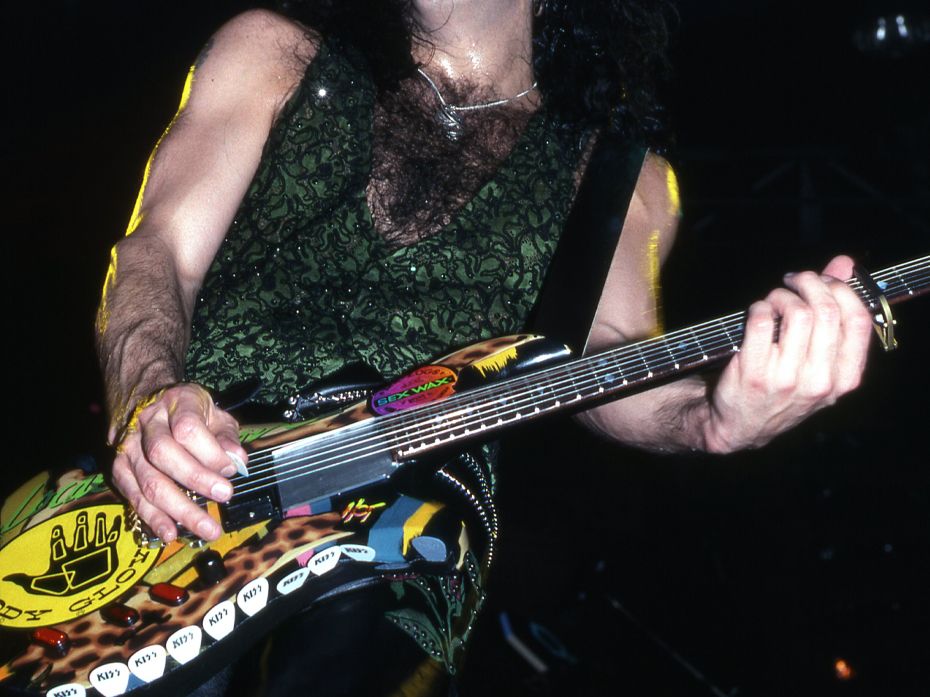
After the Mockingbird, Paul got himself a custom leopard paint job B.C. Rich Eagle. We don't know quite when he got it but it was in his hands for the press conference/video shoot at Zoetrope Studios in October 1982. Paul's Eagles were made of maple and had standard features like the Grover Rotomatic Imperial tuners, an all-brass Quadmatic bridge, and a brass truss rod cover. Also a standard feature—and a first for Paul—the Eagle had 24 frets. According to B.C. Rich this guitar was delivered with a DiMarzio Super II in the bridge position, but all available photos show the guitar with EMG 81's. Like the Mockingbird the electronics had been greatly simplified and looked more like the relatively simple layout of the import, and lower-priced, NJ series which was introduced in 1983.

It's best to get one thing out of the way right at the start so that I don't have to use two sets of "names" during this section. Paul had two Eagles in 1982-83. We don't know if he got them at the same time or if the second was acquired when he realized that the first was an instrument he liked. They had identical specifications and really only differed in the paint job. The guitar I've been writing about so far will henceforth be called Eagle no. 1 and it's slightly less animal-like "brother" (see below) will be called Eagle no. 2. 

Eagle no. 1 was the guitar during the brief run of promotional playback "performances" in Europe during November and December but I have a feeling that was out of necessity. I have nothing to support this but I think the Eagle made this trip because the Hamer Vector and custom Standard were being re-finished with their own animal print designs. Once the 10th Anniversary Tour started Paul mainly relied on the newly zebra-striped Vector with the tiger Standard as his second. At the time he clearly preferred those two and if they had been available in late 1982 I have a feeling he would have brought the Vector. Just like he did for the Applausos playback performance in 1981.

Hilversum, Holland November 1982
Top Pop Studios

Munich, West Germany November 1982
Vorischt Music

Rome, Italy December 1982
Channel 5 Mixer

Even though the zebra striped Hamer Vector was Paul's main guitar for the 10th Anniversary Tour, Eagle no. 1 slowly got more playing time over the first two months of the tour. It often opened the show as we can see from the photos below where it has a capo at the 3rd fret for "Creatures of the Night". 

Lexington, Kentucky January 6, 1983
Photographer unknown

Saginaw, Michigan January 7, 1983
Photo by Steve Trumbull

Quebec, Canada January 12, 1983
Photographer unknown

But as the tour went on the Eagle no. 1 got more playing time. As we can see below it was used for other songs which didn't require a capo and, at times, was even used for the end of the show. The photo from Norfolk below show that Eagle no. 1 was used for the tank finale for that show. (And, coincidentally, it was also used to open that show.) 

Toledo, Ohio January 8, 1983
Photographer unknown

Norfolk, Virginia
Photographer unknown

Richfield, Ohio February 22, 1983
Photographer unknown

And here is as good a place as any to note two minor details. First, the tuners of Eagle no. 1 had been changed, most probably before the tour began. We have comparatively few good photos of the headstock of Eagle no. 1 but we can see that the Grover Rotomatic Imperial tuners ahd been replaced by Paul's preferred Schaller M6. Eagle no. 1 also had a small symbol and some text on the back of the body. For obvious reasons this has rarely been captured by cameras. I would wager a guess that the text says B.C. Rich but there are no photos that are clear enough to say for sure.

And then, enter stage left: Eagle no. 2. Starting on March 1 it seems to have taken over the capo duties from Eagle no. 1 as seen in the photos below.  Eagle no. 2 had a finish that was similar to Eagle no. 1 but the "spots" were a lot more drawn out and pointy, unlike any animal I can think of. That type of descriptive language has a tendency to mean very little but in a side-by-side comparison the difference is easy to see.

eagle no. 2

Kansas City, Missouri March 1, 1983
Photo (possibly) by Didi Zill

Universal City, California March 27, 1983
Photographer unknown

San Fransisco, California April 3, 1983
Photographer unknown

When Eagle no. 2 handled the opening of the show, Eagle no. 1 was "free" to roam and was seemingly used whenever Paul felt like it. Based on the photos available to me it had no specific spot in the set when it was called upon.

eagle no. 1

El Paso, Texas March 23, 1983
Photographer unknown

San Fransisco, California April 3, 1983
Photographer unknown

1983-84

b.c. rich eagle

When the newly unmasked KISS set out to raze Europe for the first time in three years, Paul brought a whopping five guitars with him. The zebra Hamer Vector was still Paul's first choice most nights, and the Mockingbird saw a lot more action than it had on the previous tour, but Eagle no. 1 saw a fair share of action. Based on the photos I have, Eagle no. 2 was not brought along for this tour, its place probably taken by the brand new zebra Warlock II. The photos below show Eagle no. 1 used for different parts of the show during the fall of 1983.

eagle no. 1

Madrid, Spain October 14, 1983
Photographer unknown

London, England October 23, 1983
Photo by Pete Still

Munich, West Germany November 2, 1983
Photographer unknown

Stockholm, Sweden November 19, 1983
Photo by Göran Lindsjöö

Hilleröd, Denmark November 21, 1983
Photographer unknown

Once the band returned Stateside Eagle no. 2 was back in business. We have no backstage instrument lineup photos to consult but I think that the zebra Warlock II was replaced by Eagle no. 2. For the duration of the US leg of the Lick it Up Tour Paul seems to have used both Eagles about equally.

eagle no. 2

Lakeland, Florida December 29, 1983
Photographer unknown

Corpus Christi, Texas January 19, 1984
Photographer unknown

Toronto, Canada March 15, 1984
Photographer unknown

Eagle no. 1

Cleveland, Ohio February 22, 1984
Photographer unknown

New Haven, Connecticut March 1, 1984
Photographer unknown

Quebec, Canada March 12, 1984
Photographer unknown

1984-85

b.c. rich eagle

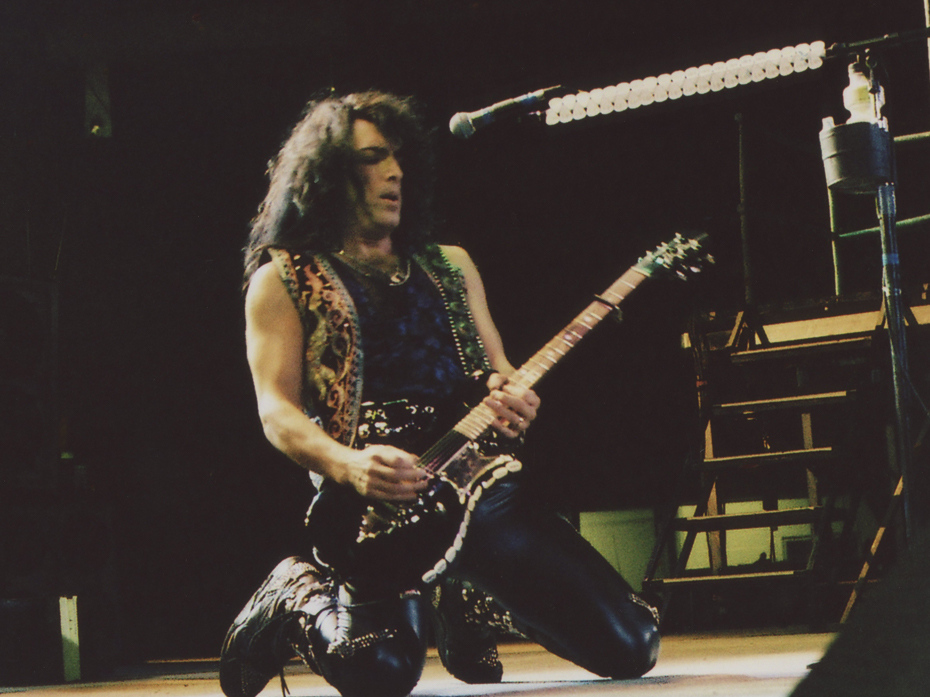
Considering that the album was called Animalize, that they re-furbished the old European Unmasked Tour stage with animal print, and even got panther heads for Eric's kick drums, I find it a little odd that Paul chose to retire both the Zebra Hamer Vector and the Tiger Hamer Standard. They were both wonderfully image-compliant. But Paul had started endorsing B.C. Rich so even though he still got the Hamer Scarab, he chose to focus on his trusted Eagles and the Mockingbird. Both Eagles were unchanged when the tour began but that soon changed. Here we see Eagle no. 1 at the very start of the tour.

eagle no. 1

St. Austel, England October 2, 1984
Photographer unknown

Glasgow, Scotland October 5, 1984
Photo by Gregg Boyd

Leicester, England October 10, 1984
Photo by Rick Francis

Try as I may I cannot see any defect in those photos. Granted, they aren't exactly stellar quality, but still. I want to believe that something should show. Because just a few days later Eagle no. 1 shows up with some gaffer's tape on the upper part of the body. The only reason I can think of why they would do that would be if the finish had suffered some damage or Paul right arm had worn it down. But there's no indication of this either at the end of the previous tour, in the one studio photo we have from this period, or in the photos from earlier in the tour. But that gaffer's tape would stay on Eagle no. 1 for the remainder of the tour. 

eagle no. 1

London, England October 15, 1984
Photo by Alan Perry

Stockholm, Sweden October 26, 1984
Photo by Anders Tengner

Brussels, Belgium November 3, 1984
Photo by Frederick Moulaert

Around the same time we see the first evidence that they had taped the control cavity of Eagle no. 1. I have a feeling that this had happened long before but there are precious few photos showing this part of the guitar so we don't really know. (We can say for sure that it was not taped during the 10th Anniversary Tour.) The photos showing the control cavity of Eagle no. 2 are even fewer, but my guess is that they started taping both guitars at the same time. And speaking of Eagle no. 2, it was still part of the arsenal but judging by the photos it got comparatively little use during this leg of the tour.

eagle no. 2

Lund, Sweden October 24, 1984
Photographer unkown

Stockholm, Sweden October 26, 1984
Photo by Göran Lindsjöö

Gothenburg, Sweden October 27, 1984
Photo by Anders Tengner

During the US leg of the our Eagle no. 1 remained the clear-cut number one. And it still had the gaffer's tape. Eagle no. 2 appeared to have settled into a role as the designated capo guitar. At least that's what the photos suggest. Some time in early January 1985 both Eagles start to have their cables secured by a piece of tape. Look closely at the photos below and you'll see it.

eagle no. 1

Milwaukee, Wisconsin December 30, 1984
Photographer unknown

Unknown location January 1985
Photo by Layne Murdoch

Long Beach, California February 1985
Photographer unknown

eagle no. 2

Charlotte, North Carolina January 6, 1985
Photographer unknown

Phoenix, Arizona February 6, 1985
Photographer unknown

Calgary, Canada March 3, 1985
Photographer unknown

1985-86

b.c. rich eagle

And then came Asylum... When pastels and bling took over the stage look, the old animal print finishes didn't cut it any more. Instead the Eagles got very different finishes and some changes to the hardware. Eagle no. 1 got a black base with pastel streaks and the original brass Quadmatic had been replaced by a chrome one. Curiously, they chose not to re-finish the headstock which still had the mahogany overlay. Note that the cable is still secured with a strip of tape. It was still Paul's main guitar throughout the tour and it even made an appearance in an ad in the tour book.

Little Rock, Arkansas November 29, 1985
Photo by Art Meripol

Unknown location December 1985
Phott by Layne Murdoch

New York, New York December 16, 1985
Photographer unknown

Some time over the course of the winter/spring of 1986, Paul changed the chrome Quadmatic back to the brass Quadmatic. I haven't been able to pin it down, the photos I have simply aren't good enough, but by the time William Hames shot the photos that were later published in Young Guitar, the bridge was brass. It's possible that the bridge was brass by March 29—see photo below—but I think we can only say for sure that it had been changed in the photos from the very last show at the Meadowlands.

Charleston, West Virginia January 15, 1986
Photographer unknown

Unknown location February 1986
Photographer unknown

New Orleans, Louisiana March 2, 1986
Photo by Mark Zumo

Columbus, Ohio March 29, 1986
Photographer unknown

Allentown, Pennsylvania April 1, 1986
Photographer unknown

East Rutherford, New Jersey April 11, 1986
Photo by George de Sota

Eagle no. 2 got a completely different finish, one that was a real eye sore. It had a day-glo yellow base with a few thin pastel streaks. I want to think that nobody could appreciate that finish but maybe it's just me. It appears as if it was originally intended to be used for "Tears Are Falling" as it had a Kahler 2310 tremolo installed. For some reason it also had the tone knob removed, but just the knob. The pot was still there. I have seen no photos that suggest that Eagle no. 2 ever made it onto the stage but there is anecdotal evidence from fans that it got used at least once.

July 1986 issue of Young Guitar
Photo by William Hames

But when Eagle no. 2 fell out of favor there appeared in its stead Eagle no. 3. This was more or less a serious attempt at a copy-paste of the Asylum version of Eagle no. 1. The finish is almost identical, and the pickups and hardware appear to have been exactly the same. Where it differed was in the inlays and the headstock, Eagle no. 3 had B.C. Rich's pointed headstock and triangular inlays. 

Side-by-side comparison of Eagle no. 1 (left) and Eagle no. 3 (right)
Photos by William Hames from Young Guitar

Looking at the photos and the available video it doesn't appear as if Eagle no 3 had a specific job, it was more of a "fil in the blanks" guitar whenever Eagle no. 1 needed a rest. But more often than not it was part of Paul's solo spot. So far I have only spotted it from mid-February and onward but my collection is slightly limited when it comes to this tour. (If I ever get my hands on the backstage guitar lineup shots that William Hames shot earlier in the tour we might be able to say more confidently whether Eagle no. 3 was part of the arsenal during the entire tour.)

Los Angeles, California February 11, 1986
Photographer unknown

Unknown location February 1986
Photographer unknown

Port Huron, Michigan March 7, 1986
Photographer unknown

Columbus, Ohio March 29, 1986
Photographer unknown

Toronto, Canada April 8, 1986
Photographer unknown

East Rutherford, New Jersey April 11, 1986
Photo by George de Sota

Eagle no. 3 was de-commissioned after the end of the tour and never seen again. Eagle no. 2 was part of the Convention museum displays and then auctioned off in 2001 as lot 1133.

1987-88

b.c. rich eagle

Under construction...

1990

b.c. rich eagle

Under construction...

1992

b.c. rich eagle

Under construction...

© No copyright whatsoever, all information on this site is free to use.
However, please credit the photographers and, if possible, the site.